Blog

  • Embracing True Transformation Through God’s Grace

    Embracing True Transformation Through God’s Grace

    In a world where “fine” has become the default answer to “How are you?”, it’s easy to settle for a life that’s merely functional but not truly flourishing. Many of us live in routines that are familiar, even if they’re not healthy, because change feels risky and uncomfortable. Yet, beneath the surface, there’s a longing for real transformation—a hope that life can be more than just surviving or maintaining appearances. The good news is that God’s invitation isn’t to a slightly improved version of our old selves, but to a completely new life, rooted in His love and power.

    Looking at Matthew 13:44-58, Jesus uses parables to reveal the nature of true change and the heart of God’s kingdom. Contrary to the common interpretation that we must give up everything to gain the treasure of salvation, the deeper context shows that God is the main actor—He is the one who seeks, finds, and pays the ultimate price for us. We are the treasure and the pearl of great value, and God’s initiative, not our striving, is what secures our place in His kingdom. This is a profound reversal: instead of us working to earn God’s favor, it is God who joyfully gives everything to redeem us.

    This truth exposes the futility of trying to staple ourselves to spiritual life through good behavior or religious activity. Real transformation isn’t about acting right, but about being made new from the inside out. Only the gospel—the good news of what Christ has done—can produce genuine love for God and others. Proximity to spiritual things or Christian culture isn’t enough; what matters is whether our hearts have been changed by God’s grace.

    Jesus’ own hometown missed this because they couldn’t see beyond the familiar. Their expectations and assumptions blinded them to the work of God happening right in front of them. The same danger exists for us: we can become so accustomed to our routines, or so convinced that God’s love is tied to our performance, that we miss the invitation to be truly found and transformed.

    The invitation remains: will you allow yourself to be found by God, to let go of striving and receive the new life He offers? The price has already been paid. The only thing left is to say yes—to surrender, to trust, and to let God do what only He can do: make you new.


    Recent Videos

    Here are the most recent message videos from Clarity Church where Phillip Santillan is the Lead Pastor.

    Proximity to spiritual things—church attendance, Christian language, or good deeds—does not guarantee transformation. What matters is whether our hearts have been changed, whether we have truly been made new by God’s grace

    – Phillip Santillan –


  • NEW YEAR / NEW YOU

    At the beginning of 2010, I was 28 years old (less than a month away from turning 29) and I had a blog. No one read it but it was a place I used as a “mental retreat” at the time.

    In a post called “The Anti-Resolutions” here’s a little of what I wrote.


    I understand why people make New Year’s Resolutions.  I just don’t do it.  New Year’s Resolutions have been responsible for making me look like a hypocrite year after year.

    correction…I make me look like a hypocrite every year.

    Regardless of my reasons, I was inspired by my friends Nick and Rachel to make some goals for 2010.  I like the sound of that.  Goals are meant to be attained. Resolutions just seem like self-promises that somehow end up being more of a burden than an encouragement.  I know this isn’t the case for everyone, but then again, this isn’t “everyone’s blog.”  This is mine!

    So here are some goals that I’m setting for myself.
    • Read 2 books a month
    • Review 1 book a month on my blog
    • Start a new Bible Reading Plan
    • Meet with a mentor at least once a month
    • More than losing weight…get healthy.
    • Go Ice Fishing and Hunting for the first time

    Out of complete transparency, I wrote a blog post the next year where I basically reported I had failed every goal.  Here’s what I had written at the end of that post:

    I did not go ice fishing or hunting.  Probably a good thing, but I’d still like to go.  In fact, I had some really good conversations with the guys in my connect group about ice fishing and hunting – despite the fact that I was the only one who hadn’t done either.  

    The fact is that I failed on that goal, but my interest in it has really help me connect in relationship with other guys who not only love fishing and hunting, but love God and others.

    Sure…I look at the fact that I didn’t “make it” with some of my goals and see how it may look like failure.  But to me, the journey is as much of the measure of success as the goal.  So here’s to more Anti-Resolutions.  A year older and a year (hopefully) wiser, these are the goals for this year as I approach living life for the first time in my 30’s (My 30th birthday is this month).

    This month I will be turning 41. It’s been a wild 12 years since that blog post and I am so excited about what this new season of life holds for me and those within my circle of influence. Even more so, I am excited to capture on this site some of the memories, lessons learned, and fun experiences along the way.

    So if you’re reading this…leave a comment and let me know what you are excited about for 2022?

  • The beginning of a dream

    12:45 am
    Friday, September 28, 2012

    When Leona finds out I am still awake she is not going to be happy. But I am going to see if I can write what is heavy on my heart before she wakes up and finds out I am still on the living room floor typing frantically away.

    God has called me to church planting.

    There. I finally said it.

    Well, I technically “finally,” said it this past Monday at our church business meeting. But this is the new reality for Leona and me, and I am more filled with faith and excitement than I have ever been in my life. I am also more humbled than I have ever been in my life.

    Let me back up a second.

    I just came back from a preaching conference in Chicago. Yes…I did just drive 8 hours and got back a little over an hour ago. I am dead tired, but I thought that before I went to bed I would just read the intro to the book received before we left. I read the intro. And then I read the first chapter. Then something inside me began to well up in what felt like a cry and a yell all at the same time.

    Andy Stanley’s book “Deep and Wide: Creating Churches Unchurched People Love to Attend” was the book. I don’t really want to go into all the detail of that first chapter – that’s what the book is for. Go buy it =)

    What I will say is this. Please pray for Leona and I. I know some of you who read my blog may have more questions since I have purposely left many answers uncovered. But what I have to say is this:

    God called me to ministry a long time ago. That call to ministry was never rooted in a “How” or defined by a “Role.” I was no perfect person. You can ask that of my childhood friends from Newport News, VA. But I met Jesus. He changed my life. He called me to live my life with the sole purpose of helping people understand the same. And what was that?

    To create a clear picture of Christ that changes everything.

    This is still the call of God in my life. Nothing in this world would give me greater honor than being someone God uses to accomplish His will of spreading the whole Gospel in a way that changes everything. Pray that I am found faithful in being submitted and available for God to do whatever he wants.

    12:59 am 
    Time for bed

  • BOOK REVIEW: THE MAKING OF A LEADER

    The Making of a Leader by Dr. J. Robert Clinton was a book I had recently picked up at the recommendation of a friend of mine in the midst of a conversation regarding leadership.

    Stylistically, this book reminded me a lot of how it felt to read through books by the Barna Group (with the exception of The Power of Vision)or from Ed Stetzer – lots of facts and observations. In a conversation with a friend over Facebook, I had mentioned that it didn’t remind me of books on leadership by authors like Maxwell or Lencioni, or Covey.

    I was wrong.

    This book does remind me a lot of Covey’s style of writing.  What I mean by that is that – like Covey – this book is best understood in the context of hindsight and is most difficultly understood if you are early in your leadership journey.  I am experiencing this with an intern I am walking 7 Habits through.  It isn’t impossible to gain insight, but it seems to me that a lack of “real world” experience (and it doesn’t take much) that it’s difficult to grasp some of the illustrations.

    To sum it up, this book was less of a book on HOW to be a good leader, but more of a scholastic observation of WHAT leaders go through to become the leaders they are.

    The thing that I appreciate the most about this book is that it is overtly from a Christian worldview and is filled with scriptural examples of principles observed of leaders in real life.  While someone who does not find their vocation in ministry may not feel this book speaks to them about how a person becomes a leader in their “ministry in the marketplace” there are plenty of great nuggets of truth that not only makes you a leader – but they are great nuggets of truth that tells you how to be an effective Christ-follower.

    Anyways, enough about that…here are some things that I found interesting from The Making of a Leader:

    • Integrity and faithfulness are preludes to success and giftedness
    • Effective leaders recognize leadership selection and development as a priority function
    • Effective leaders increasingly percieve their ministries in terms of a lifetime perspective
    • Apart from character, ministry is only religious activity or even worse, religious business
    • A leader must learn obedience in order to influence others toward obedience
    • The right to influence comes form the ability to clarify God’s truth to others.
    • It is self-initiation in the entry patterns that indicates strong potential for upper-level leadership
    • Those who self-initiate often disrupt the status quoand threaten those in authority over them…Leaders need to recognize the value of this quality and be on the alert for those emerging leaders who demonstrate it
    • A spiritual gift is a unique capacity for channeling the Holy Spirit’s power into a ministry
    • Sometimes being right on certain issues is less important that maintaining a positive relationship
    • What we truly are is revealed in crisis
    • …high-level leaders are known for reading widely and for their capacity to apply lessons to their own lives from what they read.  The ability to do this often short-circuits the years it would have taken to learn the same lessons by personal experience
    •  Spiritual authority comes out of an experience with God. A leader does not seek spiritual authority; a leader seeks to know God.
    • People in power usually win whether right on a given issue or not 

    That last point is the hardest lesson I had to learn on my own.  As one mentor of mine puts it, “It’s the Golden Rule of power.  He who makes the gold makes the rules!”

    If you have just started in vocational ministry, this would be a good book to read every couple of years to assess where you are at in your leadership journey and to keep you from having unrealistic expectations on how you are supposed to be developing as a leader.  If you have been in leadership for a while, this is a great book for you to look back at your experiences and evaluate with clarity how well or how poorly you navigated the stages of leadership – and to make adjustments regarding the future of your leadership journey.

  • BOOK REVIEW: Organic Community

    Every once in a while I pick up a book that I really like.

    This was not one of those times.

    Organic Community – for me – can be summed up in this excerpt from the book.

    “A theology of God as creator of organic order, however, allows for collaboration with him…He gives up a measure of control to facilitate relationship with us and to demonstrate his love.”

    I never in my wildest dreams would think I would be saying this, but I think the influence of Reformed Theology has led me to be hypersensitive to anything that “resembles” Open Theism.  I am not one who likes getting into theological debates – in fact, I disdain them.  This is not an attempt to debate, so if you start it, don’t expect me to jump in.

    The reason I bring this is up is that I believe that your theology of God directly affects your philosophy of ministry and more specifically, your ecclesiology. With that said, it’s obvious that – even before I got to page 130 where the above quote is found – there were many parts of the book that I just couldn’t connect with.

    I am a firm believer that there are always things to learn, and sometimes the biggest lessons in life happen when you let someone who you disagree with in life speak to you so you can wrestle with the Lord in prayer and through God’s Word as to whether it is something that God is trying to teach you.

    So here are a few things that I did resonate with, or at a minimum, challenged my thinking:

    • Sometimes we focus so much on building a “healthy church” that we forget to tend to the health of the people.
    • There is a difference between being organic and seeking organic order. It is the difference between an infant’s response to her body’s need to release waste and her father’s need to do the same.  If her father were to respond to this need in a strictly organic way, he too would need diapers.
    • At their best, small groups supply an organic-ordered environment form some people in some seasons of their lives to grow their sense of healthy community and belonging.  At their worst, small groups deliver a manufactured environment that is promoted for all people and for every season.
    • …we cross a line when we attempt to prescribe small groups as the answer for everyone and for every season of a person’s life.
    • We need to bear in mind that the most accurate word to describe the process of forcing intimate connection is rape.
    • Do we use a master plan to prescribe the way people should belong? Or do we – with relaxed intentionality – create environments that validates the patterns people naturally use to connect?
    • …measurement has these properties:
      • We measure that which we perceive to be important
      • That which we measure will become important and will guide our process
      • That which we do not measure wil become less important
    •  Story is the measure of community

    So would I recommend this book for creating a philosophy and/or theology of how to build community in the context of a local church?  No…it wouldn’t be one I would recommend if it was the only one you picked up, but it is a good one to pick up for perspective.

  • Book Review: Developing a Vision for Ministry in the 21st Century by Aubrey Malphurs

    “ok” describes my experience with this book. It is a good read – but not great.  There are a lot of other great books (here, here, or here) on the topic of “vision” that say what Aubrey Malphurs says in a less antiquated way.

    Antiquated?

    Yes…outdated.  Old.  On the verge of irrelevant.  In fact, there is a section of the book that I literally marked in pen:

    “Warning: From here to the end of the chapter some/most of the advice is outdated”

    It’s also widely known that – in the world of casting vision for ministry – Aubrey’s protege, Will Mancini, has now become the master.  So if you’re looking for a defining book on vision in the same style and vein as Aubrey, pick up Will Mancini’s “Church Unique”

    With all that said, there were some bright spots in Developing a Vision for Ministry by Aubrey Malphurs.  As a “next-generation” pastor, I do find a connection to leadership models that are described as being more “flat”, but the longer I am in leadership in ministry, the longer I have realized that “flat” leadership is not only unproductive but unbiblical.  I appreciate Aubrey’s passion to communicate the need for Point Leadership with a God-inspired vision.

    Having now served in vocational ministry for over a decade, I do wish I had read this book early in my days of ministry to have been warned of the “dark side” of leading in the ministry setting.  Describing these situations is something Aubrey does a very good job with – remaining biblical and simply stating the facts without coming off as a “negative Nancy.” In fact, as I was reading this book, there were many times I would flashback to previous times in ministry.

    There are also other things that I found to be points with which I found either interesting or points that I resonated with. Here they are in no particular order:

    • an organization can sustain only a single ministry vision.  Most often a ministry with multiple visions ends with a split.
    • Today’s emphasis on coleadership, especially in the church where it is known as lay elder rule, attempts to be biblical but most likely is an overreaction to leadership by a single tyrant or despot, or in some cases to weak or unskilled professional leadership.  Not only is there a problem with finding a biblical foundation for coleadership, the greater problem is that people cannot follow a group.
    •  A church or parachurch ministry’s vision begins with and is the primary responsibility of the point person.
    • Cutting edge organizations are characterized by a whirlwind of activity and catalysmic change
    • There are “squeaky wheels” with solutions, but their solutions are characteristically out of touch with the ministry and its times…Visionary leaders are completely different from squeaky wheels
    • If people do not understand the vision, then in effect there is no vision.
    • [Other leaders] role is to follow the visionary’s leadership, aid in developing the dream, rally support behind it, and pass it on to as many people as possible.
    • Character is the foundation of Christian leadership….If the character is flawed in some way, then the ministry will be flawed proportionately.
    • …leadership is about comping with change, while management is about coping with complexity.
    • If an environment has not been established where people have freedom to fail then people will not take risks, and the ministry will either plateau or decline.
    • Human sources of discouragement
      • Vision vampires…well intentioned Christians who sincerely believe they are correct in opposing the vision…see themselves as courageous defenders of the faith rather than defenders of the status quo, for many of them confuse the status quo with the faith.
      • Vision vultures…people who like things the way they are, because they feel so intimidated and threatened by change
      • Vision firemen…when they hear of a good vision, run and grab the nearest fire hose to put it out…they are pure managers in leaderhip positions who do not properly understand leadership and its relationship to management…they feel threatened by innovative dreams and beleve it is in their vested interest to protect the institution from change rather than to work with leaders to procure change.
    • If the person who differs with the ministry leader is also a leader, then a decision will have to be made as to whether or not that person should stay with the ministry or pursue that which is closer to his philosophy in another ministry.
    • Some people in ministry organizations are well-intentioned troublemakers.  They work their way up through the ranks of a ministry organization until they reach a leadership position.  They appear to be loyal to the ministry and are very faithful to it.  In the church they are people who carry a Bible and are present at all the meetings of the church.  They give regularly and show up on church workdays…however, these people have a different vision with a different agenda.  They manifest themselves through their constant opposition to the visionary leader and the vision.  It becomes obvious that he will not be able to lead them.  This is because ultimately they, like Diotrephes in 3 John 9, want to control the organization.

    So…with all that said, if you are new to ministry or trying to sort out whether or not God is calling you to ministry, this book has some really great practical skills for not only finding God’s vision for your ministry, but it clearly gives you pragmatic – super practical advice – for how to handle opposition to vision and what that will look like in ministry.

    For those who have been in ministry for over 5 years, you will most likely read this book and cringe in remembrance of the times you faced opposition to vision, or even how poor execution of leading with vision effectively came back to impact you and your ministry negatively.

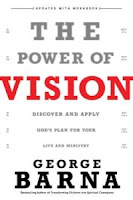
  • BOOK REVIEW: The Power of Vision

    I have written many posts on the subject of leadership and vision.  It seems at this particular point in my life that I am finding myself with more books on the subject of vision more than any time before.

    I have enjoyed other books on vision like Church Unique and Visioneering – and The Power of Vision: Discover and Apply God’s Vision for Your Life & Ministry by George Barna does not disappoint.

    As I usually do in my “book reviews” – which are more like book teasers than an actual review – here are just a few things that stuck out to me in reading this book.

    • Vision is NEVER about maintaining the status quo
    • The future belongs to visionary pastors because they will define the future.  It is the power of God working through churches led by visionaries that causes that image of the future to become reality
    • All leaders are visionaries, but all pastors are not leaders
    • A visionary leader is a change agent
    • Myth 1: Vision should be the result of a consensus among the church’s key leaders regarding future activity by the church.  Reality: Vision is not the result of consensus; it should result in consensus.
    • The visionary leader is one who is a change anent.  In the process of pushing the church forward, the leader insists on aggressive effort; remaining stationary is tantamount to losing ground.  Without risk, no progress can be made
    • A crisis is simply a turning point at which your ability to lead is tested.
    • “One of the chief lessons for me was discovering the difference between doing what people expect a pastor to do and doing what God has called me to do”
    • A ministry that aims for something other than change invites euthanasia
    • A vision from God goes beyond the simple recognition that change is healthy; it celebrates the ability and opportunity to change
    • In the end, you are the only person who can limit your ability to dream big with God

    There is soooooo much more than this book entails that I just can’t write here with good conscience because it would be on the verge of breaking copywriter licenses 😉
    If you are a pastor you MUST have this book as part of your library.

  • Book Review: Strengths Finder 2.0 by Tom Rath

    I must be upfront and honest and say that this isn’t a true book review.  For those of you who are familiar with Strengths Finder, it’s less about the book and more about the tool for finding your potential strengths.

    One of the things I learned by reading the book is that the title is misleading.  The test you take to find your strengths is really a test to find your TALENTS.

     This is what is says on pg 17:

    “What StrengthsFinder actually measures is talent, not strength”

    So what are my Talents?

    1. Futuristic
    2. Strategic
    3. Achiever
    4. Learner
    5. Belief

    Here is a breakdown of what these talents mean:

    Futuristic
    People who are especially talented in the Futuristic theme are inspired by the future and what could be. They inspire others with their visions of the future.

    Strategic
    People who are especially talented in the Strategic theme create alternative ways to proceed. Faced with any given scenario, they can quickly spot the relevant patterns and issues.

    Achiever
    People who are especially talented in the Achiever theme have a great deal of stamina and work hard. They take great satisfaction from being busy and productive.

    Learner
    People who are especially talented in the Learner theme have a great desire to learn and want to continuously improve. In particular, the process of learning, rather than the outcome, excites them.

    Belief
    People who are especially talented in the Belief theme have certain core values that are unchanging. Out of these values emerges a defined purpose for their life. 

    I totally recommend this resource.  Both Leona and I have done this and it is not only a great tool for the professional context, but the interpersonal relationship context as well.

  • Don’t Play it Safe

    A couple of weeks ago I showed this clip in a talk about developing a passionate heart for God as we walked through 2 Samuel 6.  Many people have asked for the video, so here it is =)

    [youtube http://www.youtube.com/watch?v=LA_uwWPE6lQ]

  • Book Review: Church Unique by Will Mancini

    I first mentioned Church Unique when I posted about it on my facebook page and have been chomping at the bit to share a review of it.  Well, I’ve finally found a day off to share with you some insight.  For the most part I really learned a lot from this book.  It challenges a lot of the perspectives I have been taught about strategic planning, casting vision, and creating a missional culture within your church – but it also confirmed a lot of thoughts that have been rolling around my head.

    Below are some quotes from the book that caught my attention.  Just because I mention them does not mean I agree with them.  Some I agree with, some I don’t, but all of them got me thinking.  If you are involved in church leadership at any level, I totally recommend this book.

    • reaching the surrounding community should be innate, driven by the church’s DNA rather than programming
    • The reality is that most people don’t think; they only rearrange their prejudices. Real thinking can be disruptive to the status quo and requires a great deal of courage.
    • The pastor on Sunday morning no longer speaks to a monolithic culture with shared experiences and anchor points….it is increasingly difficult to discern and then lead from a common DNA
    • (Defining the “stuck church”) They simply define their vision in terms of glorifying and propagating the past.
    • …strategic planning is no longer the preferred tool for leading the church into the future…change now happens so fast that the planning processes of yesteryear are obsolete.
    • Sending is not something you do, but being sent is something you are.
    • This is exactly what happens when church people resist change in a program. They simply don’t want their personal value to drop to zero (who does?)
    • Would you rather rally a hundred people into one effective initiative, or have a hundred people going in a hundred directions?  Inadvertently most churches tend toward the latter.  When they do, they often sacrifice their cooperative potential for the well-intended whims of the individual.
    • Missional leaders need to polarize this same reality for their people.  It should be clear that the most important people are those outside the church.
    • …differentiate or don’t exist…people desrve to know why your church is special, what God is doing uniquly through your leadership, and why they should sacrificially contribute.
    • You walk into a church you have never attended and pick up a guest brochure at a welcome center. On the inside flap you see a nice mission statement.  Then on the next page (and the rest of the brochure) you see umpteen ministries, listed from A to Z.  As you stare at the brochure, a paralytic effect ensues.  “What in the world do I do next?” you momentarily wonder.  Then you choose to do nothing at all.
    • Growing people grow people.  Consuming people consume programs.
    • …stop vision casting to making the church better and show people how the church makes life better…”Now is the time” is the mantra of the leader\
    • Everyone in your organization is in one of four categories
      • Stowaways: people who don’t know the vision and don’t want to contribute
      • Passengers: people who do know the vision and don’t want to contribute
      • Crew: people who do know the vision and do want to contribute
      • Pirates: people who don’t know the vision and do want to contribute
    • To want to contribute and to not agree with the vision is an act of piracy, whether the person has harmful intentions or not
    • role of worship is to keep the community so God-centered that the euphoria of being used by God doesn’t replace intimacy with God Himself.